Leadership without authority, often referred to as lateral leadership, is considered the ultimate discipline of management. Whether in matrix organizations, agile project teams, or volunteer work, anyone who has to deliver results without being able to issue “orders” needs more than just diplomatic skill. They need a deep understanding of the framework in which collaboration takes place.
This became clear to me once again in one of our recent board meetings at the bdvb – Bundesverband Deutscher Volks- und Betriebswirte e.V.. The challenge was not the lack of will, but the question: How do we prioritize effectively when the classic hierarchy is missing as a sorting mechanism?
The central challenge: Influence instead of authority
Leadership is based on trust, expertise, and communication. But in the practice of committees and boards, “persuasion” alone is often not enough. When highly qualified experts come together on a voluntary basis, different realities from different industries and organizations collide.
The key question is: How is decision quality created when you can’t instruct anyone?
Insight: Structure beats will
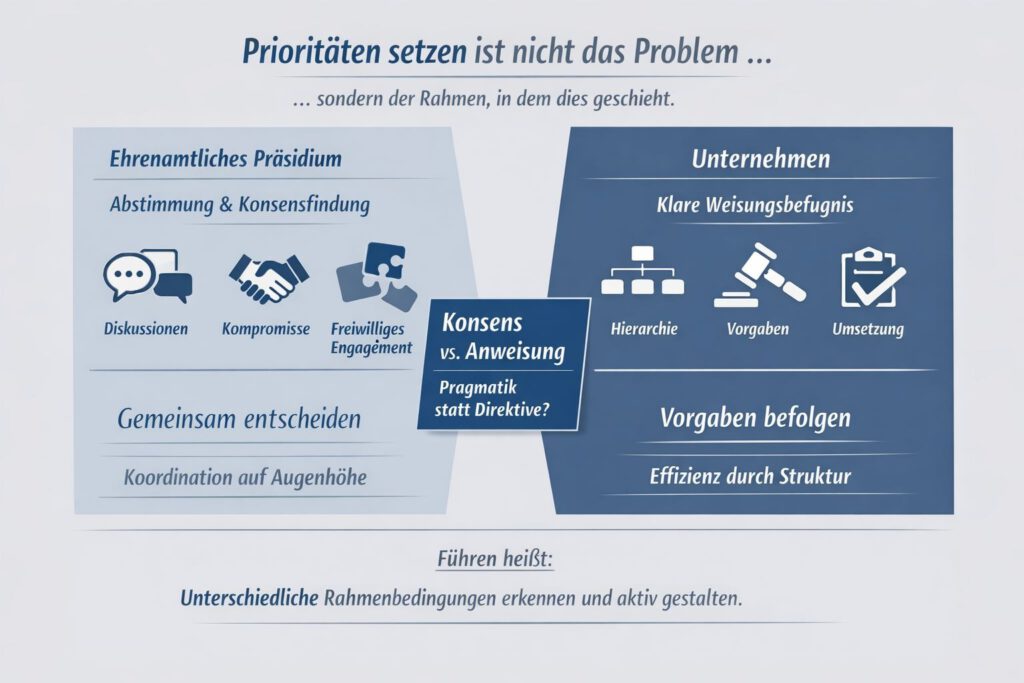
The attached graphic illustrates the area of conflict. While companies rely on efficiency through structure and clear hierarchies, the voluntary board lives on consensus-building. The risk: Endless discussions that slow down voluntary engagement rather than promote it.
True leadership without authority here means actively shaping the framework. In volunteer work, structure is not a limiting factor, but a safe space. Whoever leads must create the space in which responsibility is not delegated, but gladly assumed.
3 strategies for successful lateral leadership in the committee
Three levers have proven effective in moving from discourse to implementation:
- Trust through expertise and transparency: Without a power base, your integrity is your only capital. Make decision-making bases transparent and listen actively before prioritizing.
- Pragmatism instead of detail: A board should steer strategically, not micromanage operationally. We have had good experiences with consistently operationalizing topics and letting “pragmatism instead of directive” prevail.
- Focus through task forces: Instead of negotiating every detail question in the large plenum, we form focused small groups. This ensures the ability to work and relieves the collective.
Practical example: From consensus to task force
In our meeting, we faced complex prioritization questions. Instead of exhausting the time in the plenum with detailed discussions, we achieved a clear consensus on the target images and immediately delegated the implementation to task forces. This change from the “discussion on equal footing” to the “structured operationalization” immediately changed the dynamics positively.
Digitalization and AI act as accelerators in this context – but only if the structural basis is right.
Conclusion: Leading means shaping the framework
Contemporary leadership in complex organizations means enabling consensus and then consistently providing structure. Leadership without authority is not a waiver of control, but a more intelligent form of coordination.
At bdvb, this work thrives on members questioning positions and supporting discourses – not as an obligation, but as part of a shared responsibility.